
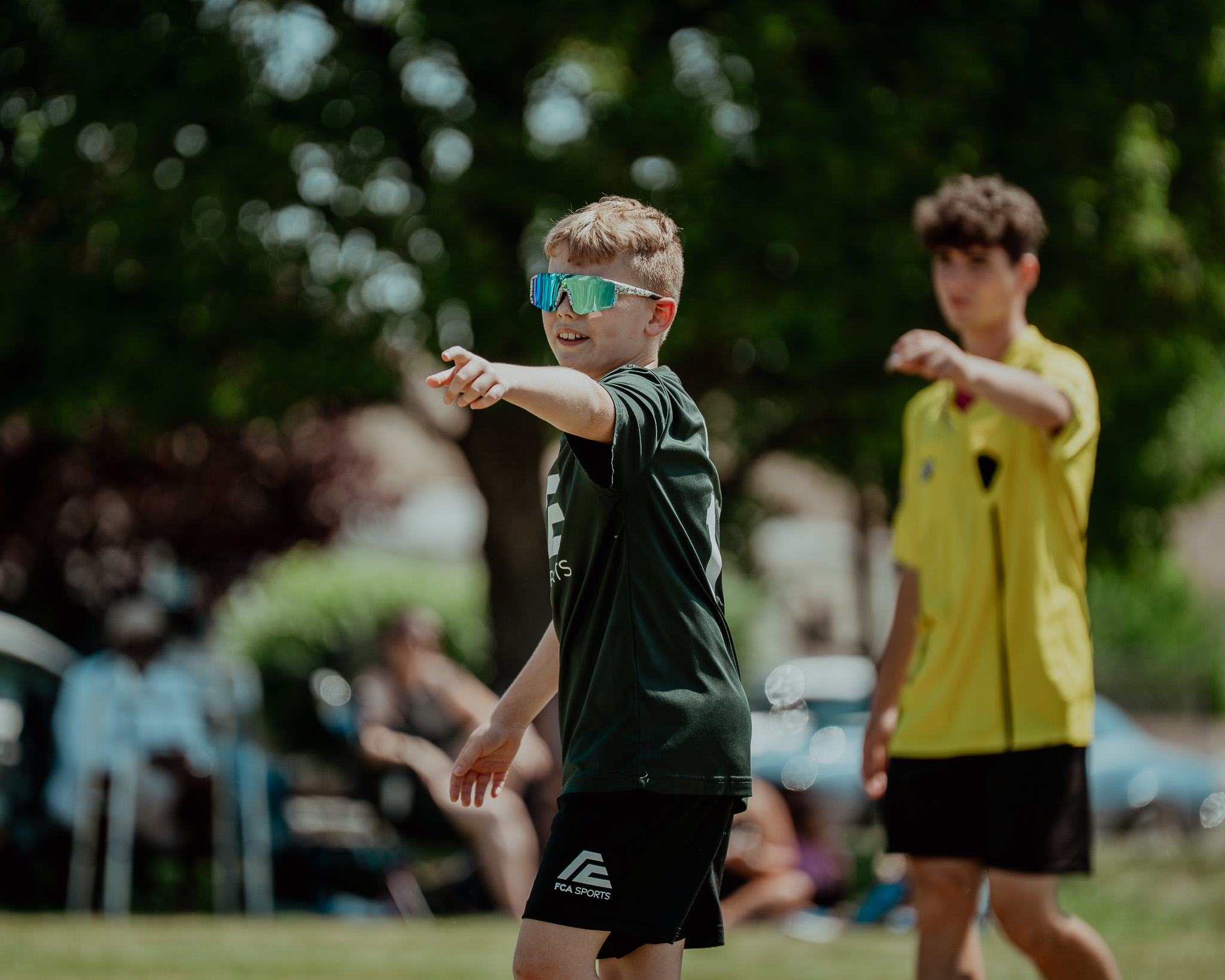
FCA Soccer Rules
FCA Sports soccer leagues are designed around three priorities: Safety, Fun, and Growth. These rules help create an age-appropriate environment where athletes can learn the game, develop their skills, and enjoy playing together.
Ages 4–5 and 6–7
Game Format
Ages 4–5
- Games are played 4 versus 4.
- Goalkeepers are not used.
Ages 6–7
- Games are played 5 versus 5.
- Goalkeepers are used.
- Teams are required to play two offensive players and two defensive players.
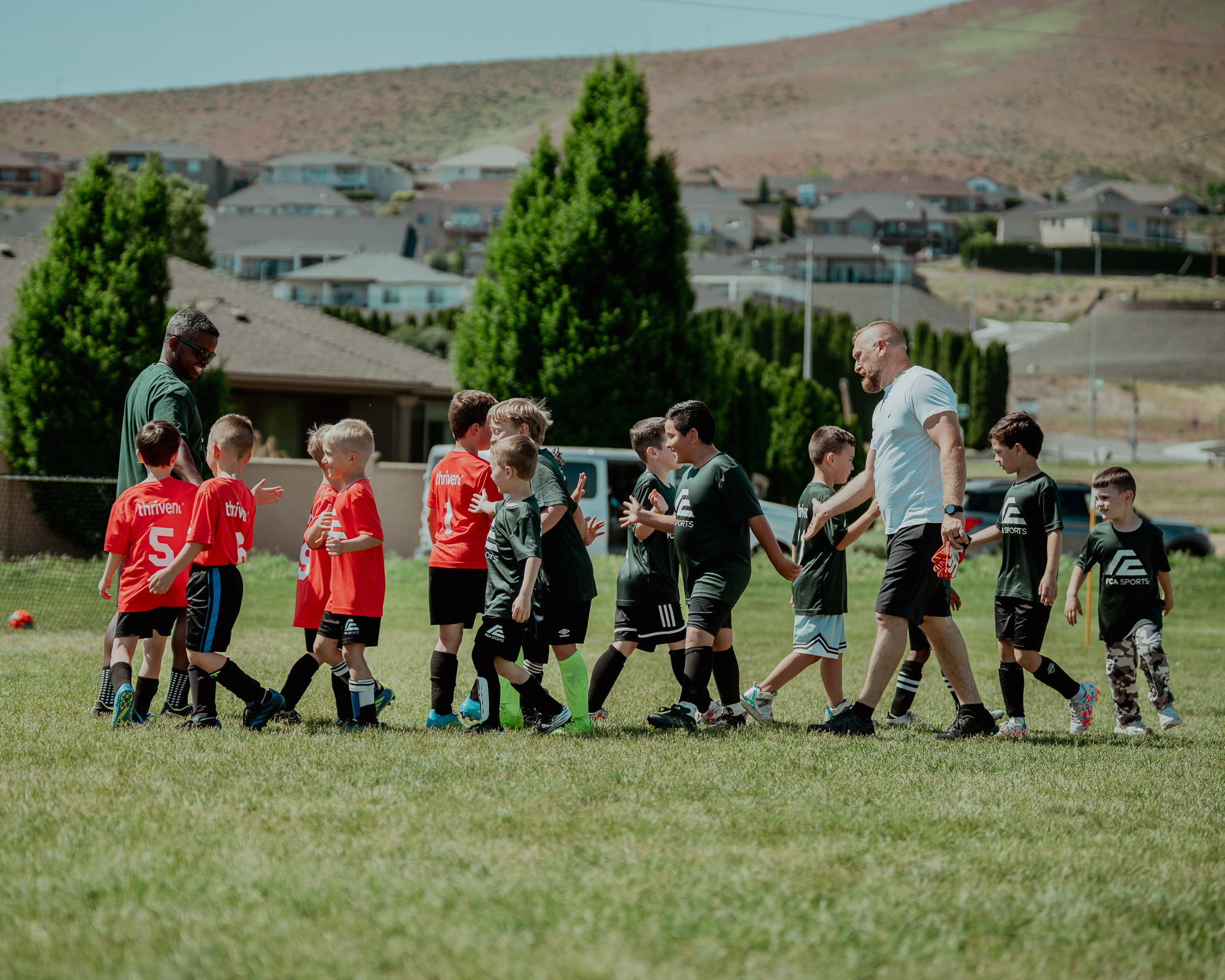
Coaches will facilitate and manage the games. Officials will not be used for these divisions.
Game Length and Substitutions
- Games consist of two 18-minute halves.
- Each half is divided into three 6-minute periods.
- The clock will stop every six minutes for substitutions.
- Halftime is five minutes.
- Coaches may choose whether to switch goals at halftime.
- A parent or coach will manage the game clock.
- FCA Sports does not officially keep score in these divisions.
Coach Meeting
Head coaches are required to meet before the game to discuss game management and establish a team-focused approach.
The goal is for both coaches to work together so the athletes can have fun, stay safe, and learn the game.
Starting and Restarting Play
- A kickoff is taken from the center circle at the beginning of each half and after a goal.
- The first touch does not have to travel forward.
- A goal may not be scored directly from a kickoff.
- At the beginning of a new 6-minute period, play will restart with the team that had possession when the previous period ended.
- If the ball remains live inside the goal arc during a scoring attempt, the offensive team may finish the play.
Throw-Ins
- Throw-ins will be used when the ball crosses the sideline.
- Coaches should use incorrect throw-ins as teaching opportunities while keeping the game moving.
Corner Kicks
- A corner kick is awarded when the defending team last touches the ball before it crosses the end line.
- Defending players must remain at least six adult strides away from the ball until it is put into play.
Goal Kicks
- Goal kicks are taken from the end line.
- The defending team must retreat to midfield and remain there until the ball is put into play.
Fouls and Free Kicks
General fouls include:
- Handballs
- Pushing
- Tripping
- Dangerous play
These fouls will result in a direct free kick from the location of the foul.
All opposing players must remain at least four adult strides away from the ball until it is put back into play.
Coaches must explain all rule violations to the player involved.
A player who commits two fouls resulting in direct free kicks during the same game must sit out for the remainder of the game. Handballs are excluded from this rule.
Player and Spectator Misconduct
Misconduct by players or spectators will be reported to the FCA Sports League Director.
If a player is required to sit out because of misconduct or aggressive or dangerous play, a meeting will be held with the player’s family, coach, and League Director.
Goal-Area Development
Coaches should teach defenders not to remain directly in front of the goal for the entire game.
Defenders may protect the goal area but must remain outside the goal arc unless the ball enters the arc.
Recommended Positions
Ages 4–5
Coaches are encouraged to use:
- One defensive player
- Three offensive players
The defensive player should stay primarily on their team’s defensive half of the field, while the offensive players stay primarily on the attacking half.
Coaches may gradually introduce and rotate the defensive position throughout the game.
Ages 6–7
Teams are required to play:
- Two offensive players
- Two defensive players
Defensive players should stay primarily on their team’s defensive half of the field, while offensive players should stay primarily on the attacking half.
The goal is to teach proper soccer spacing and positions while preventing all players from crowding around the ball in a “beehive.”
Dangerous Play
Players may not kick at the ball while lying or sitting on the ground.
Player Equipment — Ages 4–7
- Toe cleats are not permitted. Toe cleats are most commonly found on football, baseball, and lacrosse cleats.
- Athletes may wear warmer clothing underneath their uniforms.
- Warm hats and gloves are permitted.
- Jewelry should be removed whenever possible.
Ages 8–9 and 10–12
Game Format
Ages 8–9
- Games are played 7 versus 7.
- Offside will not be called.
Ages 10–12
- Games are played 9 versus 9.
- Offside is in effect and will be called to the best ability of the referee crew.
Goalkeepers are used in both divisions.
Game Length and Substitutions
- Games consist of two 21-minute halves.
- Each half is divided into three 7-minute periods.
- The clock will stop every seven minutes for substitutions.
- Substitution periods should last no longer than 60 seconds.
- Substitution periods are not coaching timeouts.
- Coaches must ensure that every athlete plays at least 50% of the game.
- Halftime is five minutes.
- Teams will switch goals at halftime.
- Extended time will not be played.
Players should have opportunities to play both offense and defense during the game.
Pregame Meeting
Head coaches are required to meet with the referees before the game to discuss game management.
Coaches and referees should work together to create an environment focused on safety, fun, learning, and growth.
Starting and Restarting Play
A kickoff is taken from the center circle:
- At the beginning of each half
- After a goal is scored
The first touch does not have to travel forward.
The player taking the kickoff may not touch the ball again until it has touched another player.
A goal may not be scored directly from a kickoff.
Before the kickoff:
- Both teams must be on their own half of the field.
- The opposing team must remain outside the center circle.
- Players must remain in position until the first touch is made.
The team that did not begin the game with the kickoff will begin the second half with the kickoff.
End-of-Period Restarts
When a period ends, the team that had possession will restart play from the appropriate location.
The restart may be:
- A throw-in
- A goal kick
- A corner kick
Ball In and Out of Play
The entire ball must cross the boundary line to be considered out of play.
If any part of the ball remains on or above the line, play will continue.
Throw-Ins
During the first game of the season, athletes will receive one additional attempt after an incorrect throw-in before possession is awarded to the other team.
After the grace period, an incorrect throw-in will result in a turnover.
Referees will work to keep the game moving. Extended instruction should be handled by the head coach rather than stopping the game repeatedly.
Goal Kicks
- Goal kicks are taken from the top of the goal box.
- Any player may take the goal kick.
- Opponents are encouraged to retreat to their own half of the field.
- The team taking the goal kick does not have to wait for the opposing team to retreat.
- The ball is in play after it has been kicked out of the penalty area.
Goalkeeper Rules
- Goalkeepers may use their hands inside the penalty area.
- Goalkeepers may not pick up a ball that was intentionally kicked back to them by a teammate.
- Goalkeeper drop kicks are permitted in both divisions.
Corner Kicks
A corner kick is awarded when the defending team last touches the ball before it crosses the end line.
Opposing players must remain at least seven adult strides away from the ball until it is put into play.
Offside
- Offside is not enforced in the 8–9 division.
- Offside is enforced in the 10–12 division.
- Offside will be called to the best ability of the referee crew.
Penalty Kicks
A penalty kick will be awarded when the defending team commits a direct-free-kick foul inside its own penalty area.
Indirect Free-Kick Fouls
An indirect free kick may be awarded for:
- Obstructing or impeding an opponent
- Extending an arm to prevent an opponent from moving toward the ball
- Preventing an opponent from getting off the ground
- High kicking above the waist of an opposing player
- Delaying the game
- A goalkeeper handling a ball intentionally passed back by a teammate
- Intentionally heading the ball
Shoulder-to-shoulder challenges are permitted when performed safely.
Direct Free-Kick Fouls
A direct free kick may be awarded for:
- Handball, including contact with the arm below the shoulder
- Kicking or attempting to kick an opponent
- Hitting or attempting to hit an opponent
- Pushing
- Charging
- Tripping
- Jumping at an opponent
- Holding an opponent
- Unsportsmanlike conduct
- Slide tackling
- Kicking at the ball while on the ground when the referee considers the action dangerous
Opposing players must remain at least eight adult strides away from the ball until it is put into play.
Major Fouls and Player Removal
The referee or coach should explain rule violations to the player involved.
A player who commits two major fouls during the same period must sit out.
A player who commits two fouls resulting in direct free kicks during the same game must sit out for the remainder of the game. Handballs are excluded from this rule.
Misconduct
Misconduct by players or spectators will be reported to the FCA Sports League Director.
If a player is required to sit out because of misconduct or aggressive or dangerous play, a meeting will be held with the player’s parent or guardian, coach, and League Director.
Slide Tackling and Heading
- Slide tackling is not permitted.
- Intentional heading is not permitted.
Scoring
- Own goals will count.
- A goal may only be scored from the attacking team’s offensive half of the field.
- A goal may not be scored directly from a kickoff or goal kick.
This rule encourages athletes to pass the ball and play as a team instead of attempting to score from the opposite end of the field.
Player Equipment — Ages 8–12
- Toe cleats are not permitted. Toe cleats are most commonly found on football, baseball, and lacrosse cleats.
- Athletes may wear warmer clothing underneath their uniforms.
- Warm hats and gloves are permitted.
- Hoodies are discouraged.
- Bracelets and rings are not permitted.
- Earrings should be removed during games whenever possible.
- A newly pierced ear may have one small post if removal is not possible.
- The post must be covered with athletic tape on both sides of the earlobe.